The Smart Buyer’s Complete Guide to Second-Hand Furniture in Kenya: 7 Proven Tips for Maximum Value (2026)
Searching for affordable, quality furniture in Kenya? Whether you’re furnishing your first home, upgrading your office, or outfitting a rental property, second-hand furniture in Kenya offers incredible value—if you know what to look for and where to look. In this comprehensive guide, we’ll walk you through seven proven strategies that help buyers save 50–70% while avoiding common pitfalls that waste time and money.
The second-hand furniture market in Kenya has exploded over the past three years. Online marketplaces like Corido now make it easier than ever to find quality pieces from verified sellers. But with that opportunity comes complexity: How do you spot quality? When should you negotiate? What’s a fair price for a used sofa in Nairobi? This guide answers all of it.
Tip #1: Know Your Market Prices Before You Shop
The single biggest mistake buyers make? Walking into a negotiation blind. You see a sofa listed for KSh 28,000 and think it’s a steal—until you realize the market rate is KSh 18,000 for the same condition and size.
Spend 20 minutes researching before you contact a seller. Browse Corido, social media marketplaces, and local classified ads for identical or similar items. Note the price range. A typical Nairobi market snapshot in 2026:
- 3-seater sofas: KSh 12,000–28,000 (quality and condition vary)
- Dining tables (wood, 6-seater): KSh 18,000–35,000
- Double bed frames (metal): KSh 8,000–16,000
- Office chairs (ergonomic): KSh 5,000–12,000
- Wardrobes (2-door): KSh 12,000–22,000
- Coffee tables: KSh 3,000–8,000
Once you know the market, you’ll instantly recognize overpriced listings and spots where you can negotiate confidently. Price knowledge is your best bargaining tool.
Tip #2: Inspect Like a Pro—The 5-Point Checklist
💡 Pro Tip: Always inspect furniture in person before committing money. Photos hide damage, wear, and smell. Online-only buyers often regret their purchases within a week.
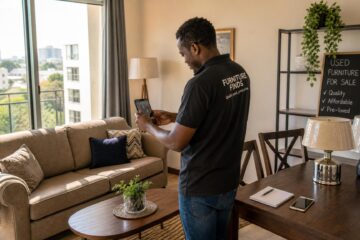
When you visit to see a piece, bring a mental or written checklist. You’re checking five things:
Structural integrity: Sit on sofas and beds. Apply weight. Do they sag unevenly? Do springs creak or feel unstable? A sofa that sags on one side now will get worse fast. Beds should feel firm—avoid any with visible sagging or broken slats underneath.
Joints and fasteners: Wiggle the corners and legs. Do they wobble? Loose joints mean the piece is aged or poorly made. A small wobble can be tightened, but major movement signals structural problems.
Upholstery and surface condition: Run your hands over fabric and leather. Are there tears, rips, or pilling? Small marks can be cleaned; large damage means cleaning costs or replacement. Check cushion covers—are they removable for washing? If not, stains are permanent.
Smell: This is critical. Sit on it for 30 seconds and smell. Cigarette smoke, pet odor, mold, and must are nearly impossible to eliminate from upholstered furniture. If you smell anything off, pass. Guest comfort (and reviews) depend on it.
Hardware and details: Drawers should slide smoothly. Handles should be attached firmly. Locks (if present) should work. Missing knobs or broken drawers aren’t deal-killers, but they’re negotiation leverage—factor in KSh 1,000–3,000 for repairs.
Tip #3: Shop off-season and build seller relationships
Furniture selling in Kenya follows patterns. More inventory appears in June–August (when people relocate after school holidays) and November–December (holiday season moving). Prices are lower during these months because supply is high and sellers are motivated.
Off-season (March–May, September–October)? Inventory shrinks, prices rise. If possible, delay major purchases to June or November when you’ll find better selection and better prices.
Also: follow your favorite Corido sellers. Message them, ask about upcoming stock, express interest in specific item types. Many sellers offer private deals (before posting publicly) to repeat buyers. A relationship that saves you 10% on five items pays dividends.
Tip #4: Spot Quality Woods and Materials
Not all second-hand furniture ages equally. Knowing materials helps you buy pieces that last.
Solid wood (hardwood or softwood): Inspect the grain. Solid wood feels dense and heavy. Knock on it—solid wood sounds hollow and deep, not plastic-y. Look for natural cracks (normal, especially in old teak or mahogany—they stabilize over time). Avoid pieces with:
- Visible rot or spongy areas (water damage)
- Termite holes or powder (active infestation)
- Large paint bubbles or peeling (sign of underlying damage)
Plywood and MDF: Cheaper, lighter. Look for delamination (layers separating) or swelling (water damage). These materials don’t last as long as solid wood, but they’re fine for temporary or budget setups.
Metal frames (sofas, beds): Run your hands along the frame. Smooth? Corrosion-free? Good sign. Rust spots or pitting? Rust spreads and weakens metal. For bed frames, ensure no bending or cracks in welds.
Upholstery fabric: Poke it. Quality fabric feels tightly woven, not loose or thin. Polyester and cotton blends are durable. Pure cotton is softer but wrinkles easily. Leather should be supple, not stiff or cracked.
Tip #5: Master the Art of Negotiation
In Kenya’s second-hand market, negotiation is expected—it’s part of the culture. But it’s not about aggression; it’s about finding a win-win price.
Start with respect. Greet the seller warmly. Acknowledge the furniture. “This sofa is beautiful—how long have you had it?” People sell better to people they like.
Ask why they’re selling. Sometimes the answer reveals leverage. “We’re relocating” = motivated seller. “It doesn’t match our new décor” = possibly minor cosmetic issues. “Space issues” = they need it gone fast. Use that context.
Make an opening offer, but anchor reasonably. If asking is KSh 25,000 and your research shows KSh 18,000–20,000 is fair, offer KSh 16,000. This leaves room to negotiate upward to KSh 19,000–20,000 without either party feeling cheated. Wild lowballs (offering KSh 8,000 for a KSh 25,000 piece) offend sellers and kill deals.
Use visible imperfections as leverage. Point out a small stain, minor wear, or missing hardware. “I’ll need to dry-clean this cushion” or “This handle is loose—I’ll factor in KSh 1,500 for a replacement.” Sellers often accept 5–10% off to acknowledge these points.
Bundle buys for bigger discounts. “I’m interested in the sofa and the two side tables. What’s your best price for all three?” Volume discounts are standard—expect 10–20% off.
Use cash as leverage. “I can pay in full right now, cash” often unlocks an extra 5–10%. Sellers prefer instant, guaranteed money.
Know when to walk away. If a seller won’t budge and the price feels high, leave. Another sofa will come along. Walking away also sometimes triggers a seller to call you back with a better offer.
Tip #6: Use Online Marketplaces Smart—Corido, Facebook, and Beyond
Corido (corido.co.ke): Kenya’s largest second-hand marketplace. Verified sellers and delivery options. Search filters let you narrow by category, price, and location. Message sellers to ask about condition, delivery, or negotiate before committing. It’s the safest bet for quality and authenticity.
social media marketplaces & Buy/Sell Groups: Vast inventory, but variable quality. Pros: Highly competitive pricing, direct negotiation, sometimes free local pickup. Cons: No formal dispute resolution, scams possible, condition descriptions vary wildly. Always inspect in person. Meet in public places for safety.
other local listing sites and other classifieds platforms: Older platforms, still active. Wide inventory, but slower response from sellers. Check seller ratings carefully.
Local newspapers’ classified sections: Surprisingly good for bulk furniture (offices liquidating, homeowners moving). Less competition, sometimes overlooked deals.
Tip #7: Budget for Hidden Costs (Transport, Cleaning, Repairs)
💡 Pro Tip: Add 15–20% to your total budget for transport, cleaning, and minor repairs. A “KSh 20,000 sofa” becomes KSh 24,000–26,000 once you factor in delivery and dry-cleaning. Account for this upfront.
Second-hand furniture rarely arrives in move-in-ready condition. Budget for:
Transport: KSh 3,000–8,000 per large item (sofa, bed, dining table) using local movers or Corido’s delivery service. Smaller items: KSh 500–2,000 via boda or personal vehicle.
Cleaning: KSh 2,000–5,000 for professional upholstery cleaning (sofas, chairs). Spot cleaning yourself: KSh 500 in supplies.
Minor repairs: Tightening joints, replacing handles, fixing springs: KSh 1,000–5,000 depending on the work. Budget a contingency here.
New linens: If buying a bed, new sheets and pillows are hygiene essentials: KSh 3,000–8,000.
A smart buyer includes these costs in the total value calculation. A sofa at KSh 18,000 + KSh 4,000 transport + KSh 3,000 cleaning = KSh 25,000 total. Is that fair value versus a new KSh 45,000 sofa? Absolutely.
Sample Smart Shopping Story
Meet Sarah. She’s furnishing a 2-bedroom apartment and has a KSh 100,000 budget.
Instead of buying random pieces, Sarah spent two weeks on Corido browsing prices. She identified a sofa at KSh 22,000, a dining table for KSh 20,000, and a bedroom dresser for KSh 12,000. Total asking: KSh 54,000.
She inspected all three in person (no red flags). She negotiated as a bundle: “All three, I can pay cash today—what’s your best price?” Seller came down to KSh 48,000. She arranged transport for KSh 6,000 (one trip, three items). The dresser needed minor cleaning: KSh 1,500.
Total spent: KSh 55,500. She still had KSh 44,500 left for a bookshelf, side tables, kitchen storage, and a few décor pieces. Everything new would have cost double that and eaten her entire budget.
Your Checklist Before You Buy
- ✅ I know the market price range for this item in Nairobi
- ✅ I’ve inspected it in person—no structural damage, smell, or major wear
- ✅ The wood/material is solid, not warped or water-damaged
- ✅ I have transport arranged and costed into my budget
- ✅ I’ve negotiated in good faith and reached a fair price
- ✅ I understand hidden costs (cleaning, repairs) and included them
- ✅ The seller is responsive and seems trustworthy
Smart second-hand furniture buying in Kenya is absolutely learnable—and the savings are life-changing. Whether you’re a first-time buyer or an experienced furnisher, these seven tips will save you thousands of shillings and help you build a space you genuinely love.
Ready to start shopping? Head to Corido to browse thousands of verified second-hand furniture listings in Nairobi. Filter by price, category, and seller rating. Message sellers to negotiate and close deals on quality furniture today.
📞 Need furniture sourcing advice?
📞 0794858010 | ✉️ ask@corido.co.ke
📍 Lavington, Amboseli Road, opposite Serengeti Apartment, Nairobi | View on map →
🌐 corido.co.ke
Frequently Asked Questions: Second-Hand Furniture in Kenya (2026)
What is a fair price for second-hand furniture in Kenya?
As a rule of thumb, quality second-hand furniture in Nairobi should sell for 30–50% of the equivalent new retail price. Benchmark prices in 2026: 3-seater sofas KSh 12,000–28,000; dining tables (6-seater) KSh 18,000–35,000; office chairs (ergonomic) KSh 5,000–12,000; double bed frames KSh 8,000–16,000. Prices above these ranges warrant negotiation.
Where is the best place to buy second-hand furniture in Kenya?
Corido Marketplace in Lavington, Nairobi is the top verified second-hand furniture platform — stock is physically inspected before listing, pricing is transparent, and buyers can view items in person. Other options include Jua Kali markets in Gikomba, Kenyatta Market, and Ngara, though quality is less consistent and buyer risk is higher.
How do I know if second-hand furniture is good quality?
Check these five things: (1) Structural joints — no wobbling or cracking; (2) Upholstery — no tears, deep stains, or odours; (3) Wood — no warping, swelling, or termite damage; (4) Metal components — no significant rust; (5) Drawers and doors — open and close smoothly. Commercial-grade furniture from corporate sources is generally more reliable than consumer pieces.
Is it better to buy second-hand furniture online or in person in Kenya?
In-person is always preferable when possible — you can inspect condition, test structural integrity, and negotiate face-to-face. However, verified online platforms like Corido Marketplace that physically inspect and photograph every item are a safe alternative, especially for buyers short on time. Never pay upfront for an item you haven’t seen or confirmed through a trusted verified platform.
{
“@context”: “https://schema.org”,
“@type”: “FAQPage”,
“mainEntity”: [
{
“@type”: “Question”,
“name”: “What is a fair price for second-hand furniture in Kenya?”,
“acceptedAnswer”: {
“@type”: “Answer”,
“text”: “Quality second-hand furniture in Nairobi should sell for 30–50% of the equivalent new retail price. 2026 benchmarks: 3-seater sofas KSh 12,000–28,000; dining tables (6-seater wood) KSh 18,000–35,000; ergonomic office chairs KSh 5,000–12,000; double bed frames KSh 8,000–16,000.”
}
},
{
“@type”: “Question”,
“name”: “Where is the best place to buy second-hand furniture in Kenya?”,
“acceptedAnswer”: {
“@type”: “Answer”,
“text”: “Corido Marketplace in Lavington, Nairobi is the leading verified second-hand furniture platform — stock is physically inspected, pricing is transparent, and buyers can view in person. Jua Kali markets in Gikomba, Kenyatta Market, and Ngara are cheaper but carry higher quality risk.”
}
},
{
“@type”: “Question”,
“name”: “How do I know if second-hand furniture is good quality?”,
“acceptedAnswer”: {
“@type”: “Answer”,
“text”: “Check 5 things: (1) structural joints — no wobbling or cracking; (2) upholstery — no tears, deep stains, or odours; (3) wood — no warping or termite damage; (4) metal — no significant rust; (5) drawers/doors open and close smoothly. Commercial-grade furniture from corporate clearances is generally the most reliable.”
}
},
{
“@type”: “Question”,
“name”: “Is it better to buy second-hand furniture online or in person in Kenya?”,
“acceptedAnswer”: {
“@type”: “Answer”,
“text”: “In-person is preferable when possible so you can inspect condition and test structural integrity. However, verified platforms like Corido Marketplace that physically inspect and photograph every item are a safe alternative. Never pay upfront for an item you haven’t verified through a trusted platform.”
}
}
]
}